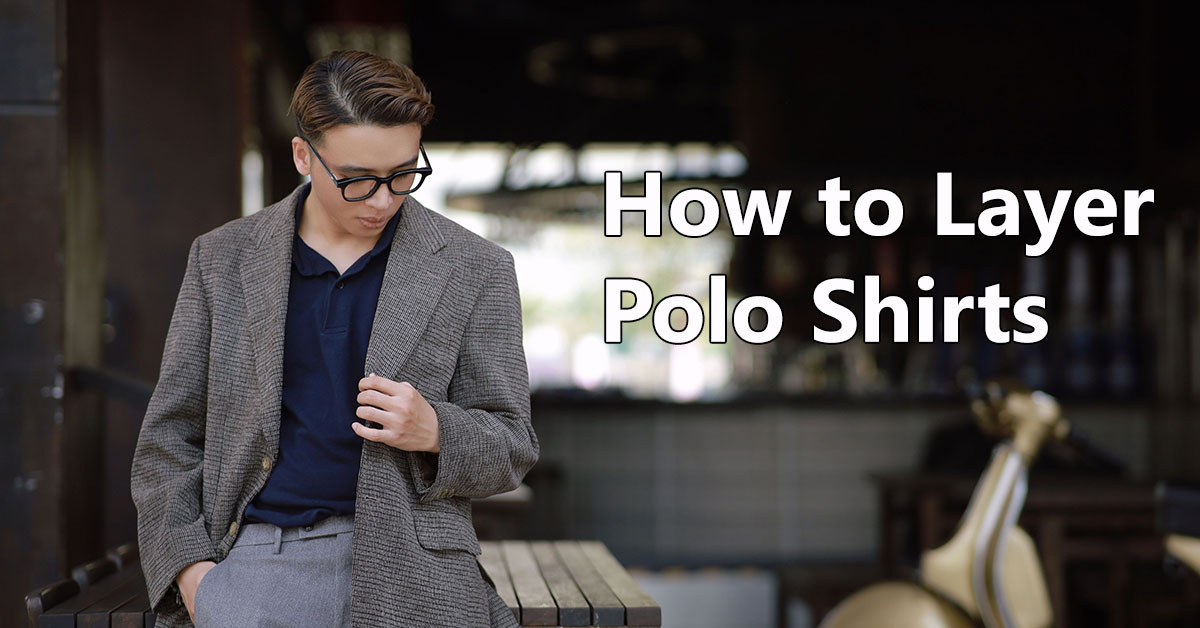
Layering a polo shirt goes wrong at the neckline, not at the outfit level. The collar is the only part of a polo that stands up, and everything you put over it either accommodates that or crushes it.
So the useful way to think about this is not by season or occasion but by what the layer above does to the collar. Get that right and the rest follows.
What’s Inside
The Collar Decides Everything
Three Kinds of Layer
Open layers — an unbuttoned overshirt, an open cardigan, an unzipped jacket — leave the collar entirely alone. The polo collar stays out and visible, and nothing is compressed. This is the easiest case and the one that always works.
Closed layers with their own collar — a blazer, a field jacket, a denim jacket — sit outside the polo collar. The polo collar goes under the lapel or inside the jacket collar, flat, not popped over it.
Closed collarless layers — a crewneck sweater, a sweatshirt — are where it fails. The neckline sits directly on the collar and crushes it, and a polo collar that has been compressed for a day carries that shape afterwards.
Why Compression Matters More on a Polo
A polo collar is knitted, not woven and fused like a dress shirt collar. It has no interlining holding it rigid, so it takes a set from whatever it spends the day pressed against.
A ribbed collar recovers better than a self-fabric one, because the rib structure has tension pulling it back. That difference, and how to recover a collar that has taken a set, is in how to stop a polo collar curling.
Fabric Weight Sets the Stacking Order
The second failure is bulk. Layering is only comfortable if each layer is thinner than the one over it, and polos vary enormously in weight.
A fine petit or mini piqué layers well under almost anything. A heavy interlock or a 6.5 oz cotton piqué is already a substantial garment and starts to fight a jacket at the shoulder and armhole.
Mesh and performance knits are the thinnest and layer most easily, though the open structure shows through a light-colored layer above. Which knit you own is set out in the polo shirt fabric guide.
Combinations That Work
Polo Under an Unstructured Blazer
The most useful of the lot. Keep the polo collar flat under the lapel, buttons closed or one open, and choose a smarter knit — piqué or interlock rather than mesh, which reads too athletic against tailoring.
An unstructured blazer works better than a structured one because there is less shoulder padding competing with the polo’s own shoulder seam.
Polo Under a Quarter-Zip or V-Neck
The traditional golf and clubhouse layer, and the collar sits properly because the opening follows the placket. Zip or button to just below the collar rather than all the way up.
Keep colors close in value. A strong contrast at the neck draws the eye to exactly the spot where layering is hardest to get right.
Polo Under an Open Overshirt
The most forgiving option and the one that works with the widest range of polo weights, because nothing touches the collar at all.
Let the polo’s hem sit above the overshirt’s, and keep the polo untucked only if its hem is cut straight — a curved tennis tail is designed to be tucked, which is covered in should polo shirts be tucked in.
Polo Over a T-Shirt
Only with a crew neck low enough not to show at the placket, and only in a color that disappears rather than announces itself. A visible undershirt neckline through an open placket undoes the point of the collar.
On a fine knit polo, skip it — the seam and hem of the T-shirt will show through.
Layering by Season
| Season | What to layer, and the polo to use |
|---|---|
| Spring | Open overshirt or light jacket over a mid-weight piqué |
| Summer | Nothing, or an unlined jacket over a mesh or fine piqué |
| Autumn | Quarter-zip or v-neck over a piqué; unstructured blazer for smarter days |
| Winter | Polo as the base under a v-neck and a coat; avoid heavy interlock as the base layer |
The broader styling question — how a polo should sit before you put anything over it — is in the guide to choosing a polo shirt.
Layering Polo Shirts FAQ
Can you wear a polo shirt under a crewneck sweater?
It is the one combination to avoid. A closed circular neckline compresses the collar with nowhere for it to sit, and a knitted collar takes a set from being pressed all day. Use a v-neck or quarter-zip instead.
Should the polo collar go inside or outside a jacket?
Inside, flat, under the lapel or jacket collar. A polo collar worn over a jacket collar reads as unintentional.
Can you layer a polo under a blazer?
Yes, and it is the most useful smart-casual layer there is. Choose a piqué or interlock rather than a mesh, and prefer an unstructured blazer.
Can you wear a T-shirt under a polo shirt?
Only if the neckline sits below the open placket and the color is unobtrusive. On a fine knit polo the T-shirt’s seams show through.
Which polo shirts layer best?
Fine knits — petit piqué, mini piqué, mesh and light performance fabrics. A heavy interlock or 6.5 oz piqué is bulky enough to fight the layer above at the armhole.
Can you layer a slim-fit polo?
Poorly. A slim cut with elastane is drafted to sit against the body, leaving no allowance under it or room for movement above it.
Final Thoughts on Layering Polo Shirts
Ask one question before putting anything over a polo: where does the collar go? If the layer has an opening that follows the placket, or leaves the collar alone entirely, it works. If it closes across the neck, it does not — and no amount of adjusting during the day fixes it.