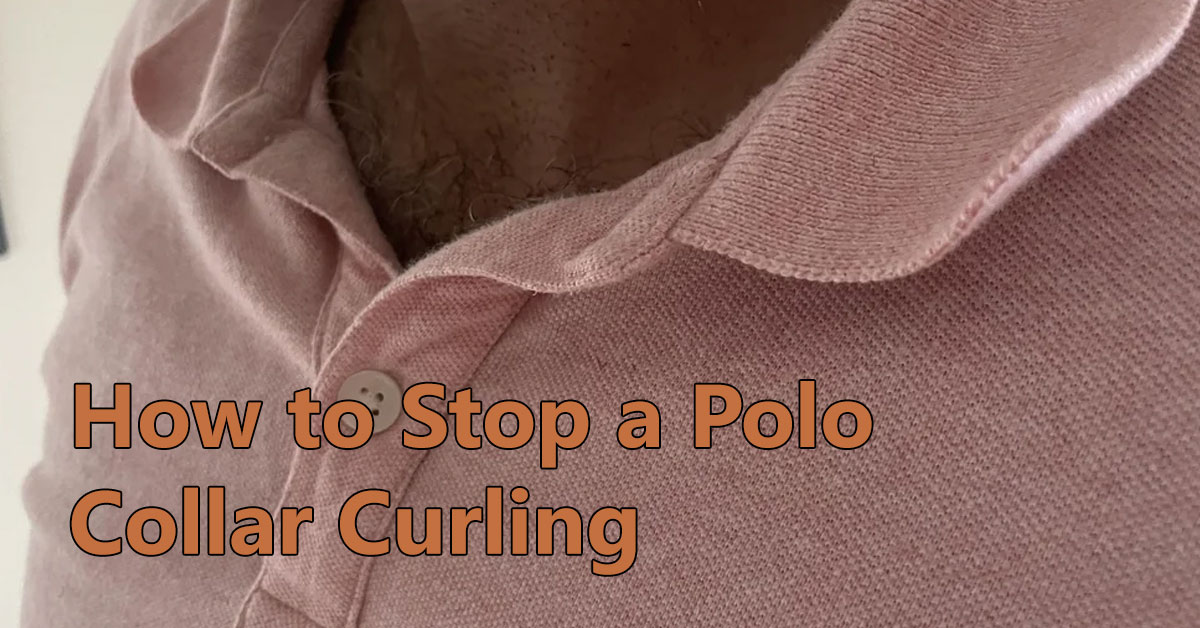
A curled polo collar is the single most common way a decent shirt starts looking cheap. It is also mostly decided before you buy — by how the collar was built, not by how you look after it.
This guide covers the two collar constructions, which one curls, how to flatten a collar that already has, and what actually prevents it.
What’s Inside
Why Polo Collars Curl
Two Constructions, Two Outcomes
A polo collar is either knitted separately and attached, or cut from the same fabric as the body. The difference decides almost everything about how it ages.
A ribbed knit collar has a rib structure — alternating raised and recessed columns — that gives it lengthwise tension and holds it flat. Nike states plainly that the ribbed collar on its Dri-FIT Victory polo is designed to help prevent curling. Callaway uses a rib knit collar too, and Gildan’s blanks use a welt knit, which is a self-finished dense edge with the same purpose.
A self-fabric collar is cut from the body jersey. Under Armour builds the UA Tech polo with a self-fabric collar. It is softer and lies flatter when new — and it has no rib structure holding it, so it is the one that curls at the points.
Jersey Curls at Cut Edges
The underlying reason is structural. Single jersey — the standard T-shirt knit — curls at its edges because the loops on the front and back faces have different tensions, so an unsupported edge rolls toward one side.
Rib and interlock knits are balanced, which is exactly why they do not curl and why they are used for collars and cuffs in the first place. A self-fabric collar is fighting that tendency with a hem alone.
The knit structures behind this are set out in the polo shirt fabric guide.
What Accelerates It
Heat and tumbling. A dryer works the collar edge repeatedly while heat relaxes and resets the fibers, which is how a collar acquires a permanent curl in a handful of cycles.
Hanging wet does it too. Water roughly doubles the weight of a knit and the collar takes the load first.
And washing the shirt with the collar standing up sets that shape as it dries — which is why folding it flat before it goes in matters more than it sounds like it should.
Fixing a Collar That Has Already Curled
Damp Heat and Cooling Under Weight
Fabric sets as it cools, not while it is hot. That single fact is what makes this work.
Dampen the collar lightly, lay it flat, and press it through a cloth with a warm iron — lower heat for blends and polyester, which glaze before cotton does. Then leave the shirt flat with a light weight along the collar until it is completely cool and dry.
Lifting it while warm undoes the work, which is the step most people skip.
What Does Not Work
Collar stays are made for woven dress shirt collars with a stay pocket. A polo collar is a knit with no pocket and nothing to hold a stay against, so they do not stay put.
Starch stiffens a knit collar temporarily and washes out, while leaving residue that makes the fabric brittle over time. And ironing a dry collar sets creases without addressing the roll at all — the moisture is what allows the fibers to move.
Preventing It
Four habits, in order of how much they matter.
Keep it out of the dryer. Heat plus tumbling is the mechanism, and removing either one largely removes the problem. Air drying flat is best; a reduced-heat cycle stopped while slightly damp is the compromise.
Fold the collar down before washing. It goes into the drum in the shape you want it to keep.
Store polos folded rather than hung, especially heavier knits, since a hanger loads the shoulders and collar continuously. Which shirts should hang and which should be folded is covered in how to hang polo shirts.
Buy a ribbed collar in the first place. It is the only one of the four that removes the problem rather than managing it, and the general wash routine that supports it is in how to wash polo shirts.
Polo Collar Curling FAQ
Why do polo shirt collars curl?
Single jersey knit curls at unsupported edges because the loops on each face have different tensions. A ribbed or welt knit collar is balanced and resists it; a self-fabric collar cut from body jersey does not.
Can a curled polo collar be fixed permanently?
Early curling can be recovered with damp heat and cooling flat under a weight. A collar that has been repeatedly tumble dried has been reset in that shape and will return to it.
Do collar stays work on polo shirts?
No. Stays are designed for woven dress shirt collars with a stay pocket. A knit polo collar has neither the pocket nor the structure to hold one.
Which brands use ribbed collars?
Nike states its Dri-FIT Victory collar is built to resist curling, and Callaway uses a rib knit collar. Gildan’s blanks use a welt knit. Under Armour’s Tech polo uses a self-fabric collar instead.
Does starch stop a collar curling?
Only temporarily, and it leaves residue that makes a knit brittle over time. It treats the symptom and shortens the shirt’s life.
Should I hang or fold polos to protect the collar?
Fold, particularly heavier knits. A hanger loads the shoulders and collar continuously, and a knit stretches under its own weight.
Final Thoughts on Collar Curling
Check the collar construction in the product photograph before you buy, and keep whatever you buy out of the dryer. Those two decisions between them account for almost every polo collar that still looks right after two years — and for almost every one that does not.