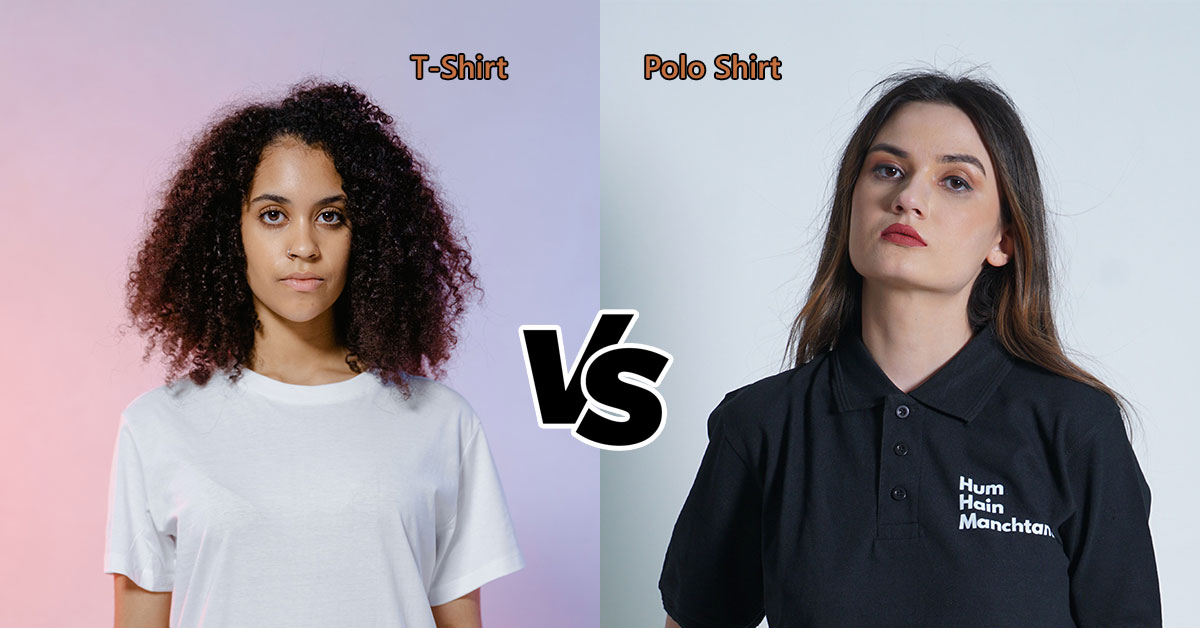
The obvious answer is the collar and the buttons. The more useful answer is underneath: the two garments are usually knitted differently, and that is what decides how each one hangs, holds its shape and reads in a dress code.
This page covers both — what you can see, and the construction that explains why a polo looks smarter than a T-shirt even when both are 100% cotton.
What’s Inside
The Visible Differences
| Feature | Polo shirt | T-shirt |
|---|---|---|
| Collar | Knitted separately and attached | None; a ribbed neckband |
| Placket | Two or three buttons | None |
| Knit | Usually piqué, mesh or interlock | Almost always jersey |
| Hem | Often longer at the back — the tennis tail | Level all round |
| Sleeve | Often ribbed or banded at the opening | Hemmed |
| Side vents | Common | Rare |
The collar and placket are what people name first, and they are the two features the garment was designed around — the collar so it could be turned up against the sun, the placket so it could be opened for air.
The Difference That Actually Matters
Piqué Versus Jersey
A T-shirt is jersey: a smooth, flat, single knit that drapes softly and follows the body. A polo is usually piqué: a textured knit with a raised waffle structure that gives the fabric body of its own.
That is why a polo holds its shape where a T-shirt goes limp, and why the collar stands rather than folding flat. It is a structural difference, not a fabric one — both can be 100% cotton and behave nothing alike.
Why Jersey Curls and Piqué Does Not
Single jersey curls at unsupported edges, because the loops on its two faces carry different tensions. That is why a T-shirt needs a ribbed neckband and hemmed sleeves — the edges would roll otherwise.
It is also why a polo collar is knitted as rib rather than cut from the body fabric, and why polos that use a self-fabric collar are the ones that curl. The mechanism is covered in how to stop a polo collar curling, and the knits themselves in the polo shirt fabric guide.
Formality: Where the Line Sits
A polo sits between a T-shirt and a button-down shirt, and it can move within that range depending on three things.
Knit. A fine petit piqué or an interlock reads smarter than an open mesh, which reads as sportswear.
Fiber. Cotton reads smarter than polyester, almost regardless of cut.
Details. A hidden placket, mother-of-pearl buttons and a plain chest push a polo toward business casual; a visible logo, contrast tipping and a mesh knit pull it back toward sport.
A T-shirt has none of those levers. It is one thing, and it stays that thing.
Which to Wear, and When
| Situation | Wear |
|---|---|
| Office with a smart-casual code | Polo, cotton, plain chest |
| Golf or tennis | Polo — most courses require a collar |
| Weekend, warm weather | Either; polo if you want to look put together |
| Under a jacket or blazer | Polo — the collar gives the neckline structure |
| Under a crewneck sweater | T-shirt; a polo collar gets crushed |
| Gym or manual work | T-shirt, or a performance polo if a collar is required |
The one hard rule is the dress code: a course or a club that specifies a collared shirt will not accept a T-shirt, and no amount of quality changes that.
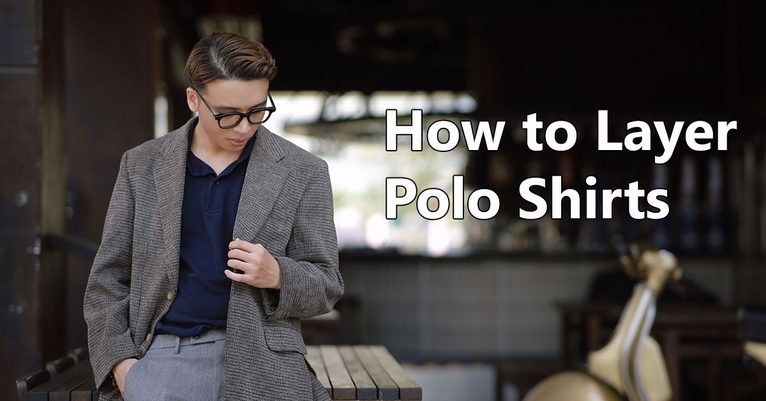
How the two layer differently is in how to layer polo shirts.
Fit Differs Too
A T-shirt has one fit consideration that matters — the shoulder seam. A polo has four, because the collar, the placket, the sleeve opening and the hem all sit differently on different builds.
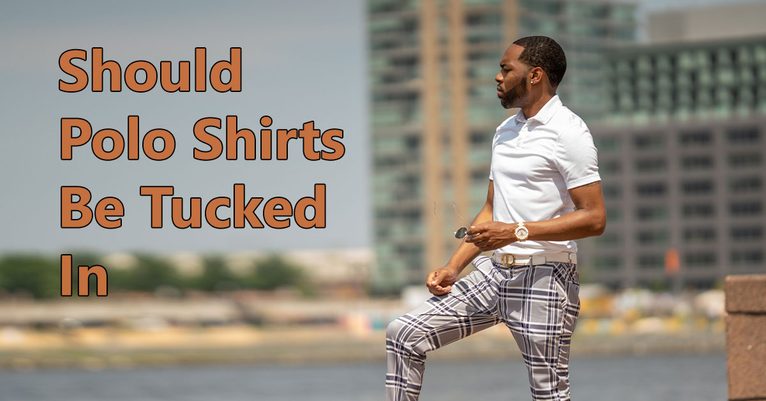
The hem is the one people miss. A T-shirt hem is level and designed to be worn out. A polo with a curved tennis tail was designed to be tucked, which is why an untucked polo sometimes looks wrong for reasons the wearer cannot name — covered in should polo shirts be tucked in.
The measurements that decide polo fit are in the polo shirt fit guide.
Polo Shirt vs T-Shirt FAQ
What is the main difference between a polo shirt and a T-shirt?
Visibly, the collar and buttoned placket. Structurally, the knit — a polo is usually piqué and holds its shape, while a T-shirt is jersey and drapes. The knit is what you actually notice.
Is a polo shirt more formal than a T-shirt?
Yes, and it can move within a range. A cotton piqué with a plain chest reads close to business casual; an open mesh with a large logo reads as sportswear. A T-shirt has no equivalent range.
Can you wear a T-shirt under a polo shirt?
Only if the neckline sits below the open placket and the color is unobtrusive. On a fine knit polo the T-shirt’s seams show through.
Why does a polo shirt cost more than a T-shirt?
More construction — a separately knitted collar, a placket with buttonholes, often side vents and a shaped hem. Piqué is also a more complex knit than jersey.
Which is more comfortable?
A T-shirt, usually, because jersey is softer and has no collar or buttons. A polo trades a little comfort for structure and formality.
Can a polo shirt be worn untucked?
If the hem is cut straight, yes. If it has a curved tennis tail it was designed to be tucked, and it will look better that way.
Final Thoughts
Look past the collar to the knit. Piqué versus jersey explains the drape, the shape retention, the formality and the price — and once you can see the difference in a photograph, most of the rest of the comparison answers itself.